Mirrors
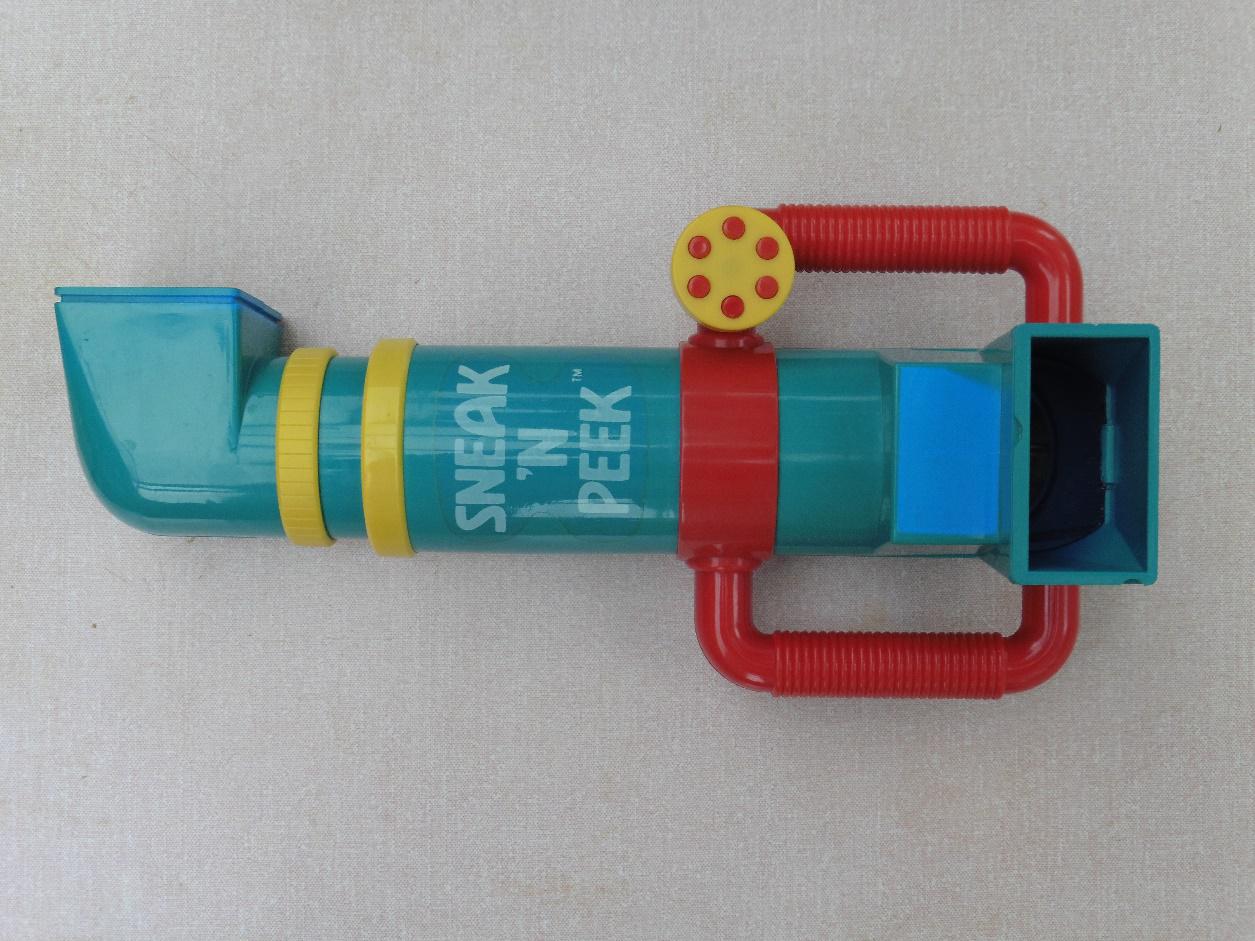
A number of toys make use of reflection.
The simplest is a small eyepiece containing a single plane mirror set at 45°.
This has at times been marketed, somewhat pretentiously, under the name ‘seebackroscope’. It enables one to look sideways at something while appearing to look straight ahead. I have even seen such a device advertised to fit on a camera to facilitate candid shots. The image is of course a mirror image, i.e. inverted (See below for a discussion on mirror images.)
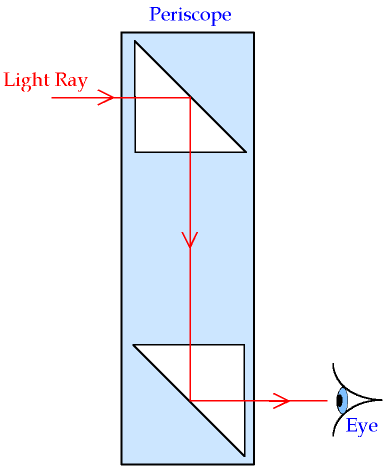
Two mirrors can be used to form a periscope to see round or over an obstacle or backwards over one's head. It can be easily made in its simplest form by mounting two plane (i.e. flat) mirrors parallel to each other and at 45° to the line of sight.
Such a device can be suitably ‘dressed up’ to make an appealing toy.
The benefit of using two reflections is that the inverted image is inverted again and comes out the right way round.
The drawback of such a basic device is that the field of view is rather narrow. One is in effect looking down a long tube out of a window. To overcome this, more sophisticated periscopes use lenses to collect light from a wider angle.
The nature of the mirror image
The inversion produced by a mirror is usually referred to in physics texts as “lateral inversion”. This term is not really adequate. True, things seen in a mirror are turned left to right (or top to bottom if viewed vertically) but this scarcely does justice to the nature of the inversion.
Essentially the reflection of a right-handed object is left-handed. Look at the reflection of a left glove in a mirror and it would fit your actual right hand – not its reflection. There is no way that you can turn the glove that will make it fit the reflection. Unless, that is, you turn it inside out! The mathematician Charles Dodgson made great play with this in his book ‘Through the Looking Glass, and what Alice found there’. In looking-glass land things happen differently. For instance, you have to run fast to stop yourself getting to another place, not to go there!
Chemists have a way of describing mirror-image molecules. They are described as ‘chiral’. The word chirality derives from the Greek for “handedness”, so it doesn't actually tell us anything different, but it does sound more scientific!
Incidentally, people are so used to seeing their mirror image that they think this is their true image. Given a choice between a photograph and a mirror image most people will choose the mirror image as a better likeness. Some computers allow you to invert the on-screen image of the built-in camera so that you seem to be looking in a mirror, rather than looking at a photograph.
The Kaleidoscope uses two mirrors at an angle to each other to produce multiple images by reflection. The resulting images display a symmetry which can be beautiful and/or entertaining.
For the images to ‘close up’ and form a symmetrical picture, the angle between the mirrors must be a sub-multiple of 360°.
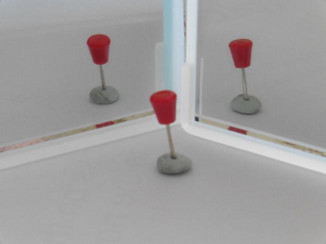
for instance 120° gives 3 images,
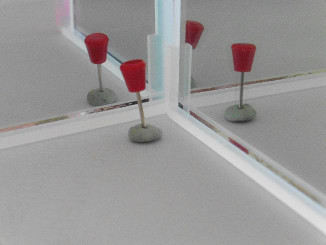
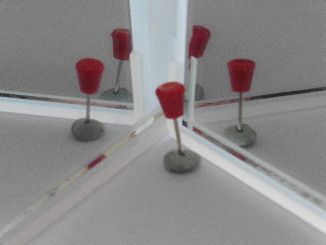
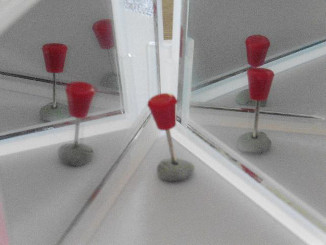
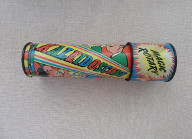
There are many toy versions of the kaleidoscope, as well as some more sophisticated, and expensive, ‘executive’ toy versions.
The simplest one in my collection consists of a cardboard tube, a piece of polished metal bent to an angle of 45° and an enclosed clear plastic box containing some pieces of coloured plastic. By turning either the tube with the mirrors or the plastic box an endless variety of patterns can be produced.
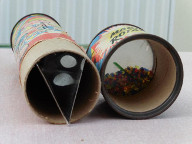
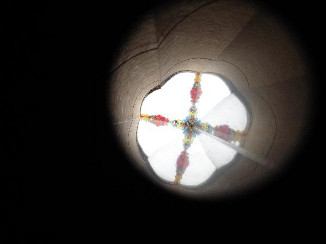
a typical pattern – never to be repeated!
Next topic: Reflection continued.Top of the page.
Start Page Useful links About me About designer Contact me
Copyright © 2009-2018, Michael & David Turvey