Slinky
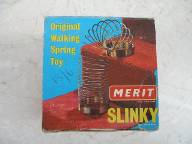
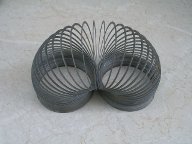
When I was doing my teacher training we were shown how “slinky”, the toy that ‘walks’ downstairs could be used to demonstrate wave motion. The local toy shops soon sold out.
Subsequently a “flat cut helical spring” (i.e. a slinky) appeared in all the catalogues of school equipment suppliers, and even double or triple length slinkies were available.
As a toy the motion down a step or slope is fascinating because most springs do not behave in this way. The slow rate at which an impulse travels along the spring, which leads to its curious behaviour, also makes it useful for showing wave motion.
The Physics
The speed of a wave along a spring depends on its elasticity (springiness) and on its mass per unit length (weight).
By having the turns of the spring flat, rather than round, the springiness is reduced to that of a thin spring while keeping the mass of a thicker and heavier spring.
Thus a longitudinal pulse (i.e. in the direction of the spring) moves slowly enough to be followed by eye. The same physical properties also mean that a transverse wave (at right angles to the spring) travels slowly as well.
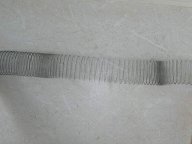
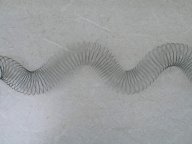
The ‘walking’ behaviour occurs because the tension in the spring is sufficient to accelerate the last few turns so that they acquire sufficient momentum to overshoot and start the next ‘step’.
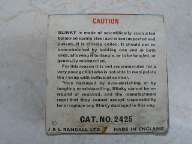
An unfortunate side-effect of slinky’s properties is that, if one snatches at it, it is very easy to stretch it beyond its elastic limit, hence the warning on the bottom of the box.
Caution
SLINKY is made of scientifically controlled balanced spring steel and when inspected and passed, it is closely coiled. It should not be over-stretched by holding one end or both ends, allowing it to dangle, or to be tangled, or generally mishandled.
For this reason it is not recommended for a very young child who is not able to manipulate the spring with sufficient control.
Once damaged by over-stretching or by tangling or mishandling, Slinky cannot be rewound or repaired, and the manufacturers regret that they cannot accept responsibility for or replace any Slinky damaged in this way.